Monday, March 26, 2012

Talking to Strangers


Hmm..yep. I'm probably going to regret this.

It was our first morning in Kep, a sleepy seaside crab fishing town about a 4 hour bus ride from Phnom Penh. The "town" itself is now a bombed-out shell of the opulent resort city it had once been during the French colonial era in Cambodia. We had rented $2 bikes to explore the countryside and the ruins of French villas that hovered like architectural ghosts among the lush palm trees.


The ride had been pleasant enough, taking us about 15km outside of Kep's main drag. As you can imagine, $2 bikes don't pack a lot of punch. After about about an hour of biking and fawning over the adorable kids who darted out from their stilted homes to yell a million "Hello!'s" as we passed, we were ready to head back for a banana smoothie and a massage.

That was about the time I realized I'd made a mistake. Having set out at 9:30am that morning, I hadn't even thought to apply sunscreen. As we pointed our bikes back toward home, I noticed the familiar sting of a newly cultivated sunburn etching its way across my arms. For those of you who've never been to Cambodia, it boasts the most intense sun I've ever experienced. Think about the nastiest sunburn you've ever gotten on the Florida panhandle after an overzealous pursuit of tan lines, then imagine pouring scalding hot water on top of that sunburn, and you might have a fraction of the burn that I ended up getting in Cambodia.

But that's a story for another post. Needless to say, I was in a hurry to get off the relentlessly sunny country road and back to shady safety. Meghna (who, as most of you are aware, is blessed with a lot more melanin) was content to leisurely peddle home, so I forged ahead and soon lost her along the winding road.


The road itself was pretty sparsely traveled, and we were only accompanied by a few passing motorbikes and tuk-tuks. Assuming to be very much alone as I huffed and puffed my way towards a shady oasis, I was surprised to realize that a man on a motorbike had pulled up alongside me and tempered his speed to match my own.

Cue American mentality. Deserted road. Unfamiliar surroundings. Companion-less foreigner. Uncomfortably close stranger. Yep, all the facets of a good old-fashioned American horror film. We had also just come from Phnom Penh, where locals had told us of Cambodia's seedy underbelly where strangers were seldom trusted and vulnerable foreigners were often targeted for thefts or assaults. These warnings lept into my mind as I realized that the man was staring at me and had no intention of resuming his pace. I flashed my best tight-lipped smile and then pretended to ignore him (a social posture perfected through countless encounters with aggressive panhandlers in New York).

"Hello." He speaks.

"Hello." I glance back to see if I can spy Meghna's silhouette in the distance. Nope.

"Where you from?"

"America." Harmless enough.

"What is your job?" Oh wow, now we're getting personal.

"I work at a technology company."

A deferential expression crinkles across the man's face. He gives me a thumbs up. "Good job. Good job. I am a teacher. I teach exercise and history to children."

My American-instilled interpersonal walls start crumbling down.

"Where do you live?" I ask him.

"I've lived in Kep my whole life. My home is here, my family, my friends, my students."

My pace slackens. My concern for the imminent sunburn on my arms fades away as I'm drawn into a fascinating conversation with my new travel companion. He tells me about his classes, and, upon learning that I taught in China, starts asking for advice on how to keep them from "playing too happy" during class. We trade strategies for engaging students, and stories on the difficulties of learning a new language. It turns out he knows a little Chinese, and our conversation morphs into a choppy stream of alternating English, Chinese, and Khmer, depending on which language best conveyed our thoughts to the other person. He points out the middle school where he teaches, and tells me its the same middle school he went to as a child. Strange, I hadn't even noticed a middle school when I passed by earlier that morning. It's amazing the things you notice when you see with another person's eyes.

We ride leisurely back into town, where I dismount and wait for Meghna. The man waits with me, making sure I'm reunited with my friend before continuing on home. And he leaves as unassumingly as he appeared beside me on the road, with a smile and a wave and an offer to email him if I ever have trouble in Cambodia.
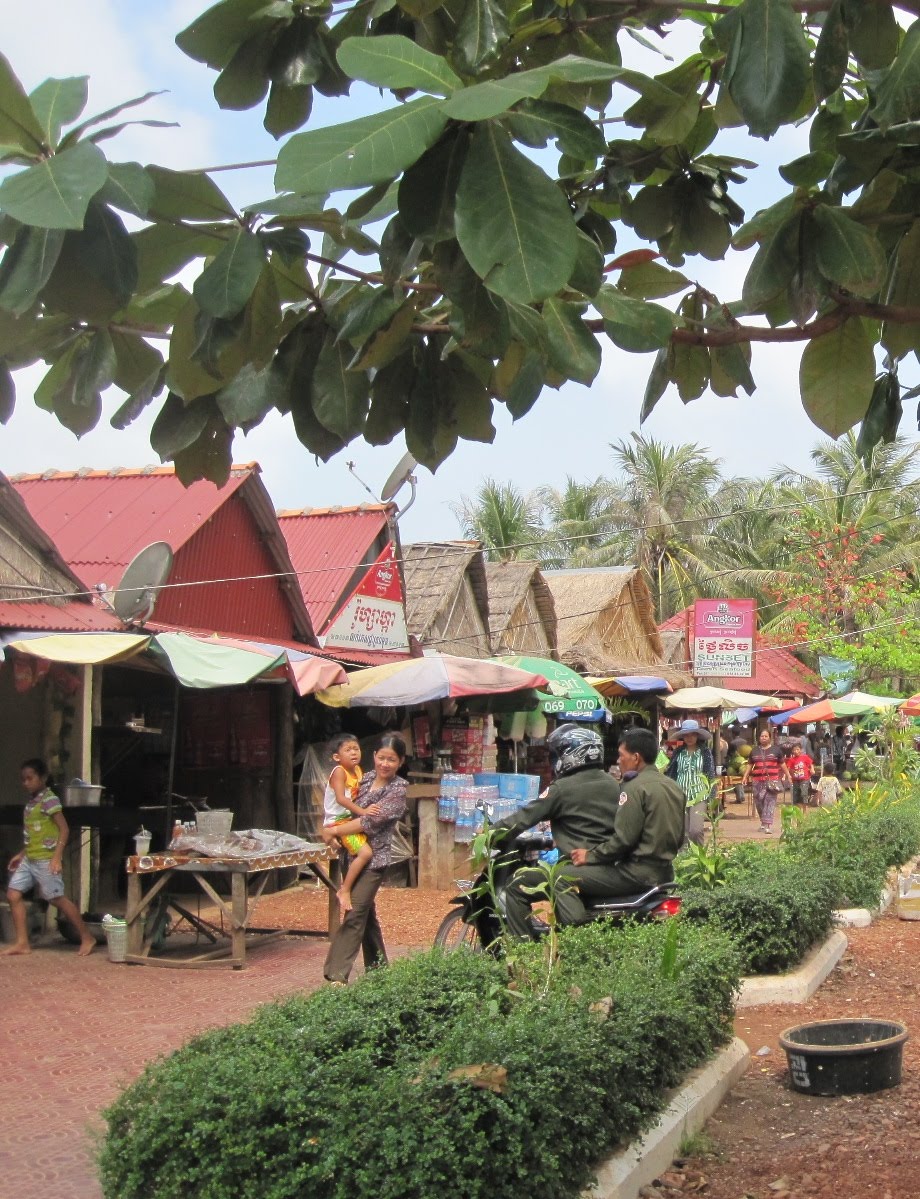


I'm always struck and inspired by the human connectivity that permeates Asia. How readily strangers jump into conversation, how eager people are to understand others. And how easy, once you push down those walls, it is to get to know another human being, even if only for a few minutes.

I wanted to rehash this bike ride for two reasons. One--it lays the groundwork for my second post about a certain disastrous sunburn. Two--it inspired my new blog title "Talking to Strangers" and a new goal I have back here in New York: to let human interactions happen, and to leave room for the possibility that a stranger can teach you something new when you least expect it.

Saturday, March 24, 2012

To say that I’ve been a bit negligent in updating my blog would be understatement.


In a world where social media absences of a few hours often invite disgust and a litany of angry reader comments, I feel like I’m obligated to deliver a compelling explanation for going MIA for about 2 years. So, in the name of redemption, here goes:

In July of 2010, I wrapped up my year in China with Princeton in Asia and shipped off to the bright lights and bustling avenues of NYC to find my way in “the real world”. In the exhausting process of finding a professional voice in a city as dynamic and competitive as New York, my adventurous traveler's spirit took a couple of hits and went sulking away into the recesses of my identity. Yes, I became, to an extent, a fast talking and even faster walking “New Yorker” with all the accompanying stereotypes and personality traits that might come to mind.

Fortunately, I’m a firm believer that, just like your biceps or your quads, your personality is a multifaceted set of “muscles” that strengthen or weaken depending on usage. So, while I’ve been taking the 50-lb dumbbell to my “career” personality for the past two years, I came to realize that my “zest for life” and “human spirit” muscles were in need of some TLC, too.

So, in February, after a 1.5 years hiatus, I dusted off (literally) my well-worn North Face backpack, packed a few shirts and a travel-sized bottle of Febreze, and set off for a long-overdue reunion with Asia.

As the plane eased its weighty body into the air and pointed its nose toward Phnom Penh, Cambodia, I reflected on my motivations for using up all my vacation days so early in the year to visit a region in which I’d already spent a lot of time. What was I trying to recapture? I realized that I hadn’t really given words to what I wanted out of my travels this time around. So, embracing that old spirit of spontaneity, I decided not to try and stamp a big, definitive, “I must achieve X profound identity revelation during this trip” mandate on my excursion. I knew I had a lot to learn from the region, and I was excited to see what Cambodia had in store for me.


Long story short, I’m back from my sojourn and am happier and more peaceful than ever. My experiences in Cambodia challenged my perspectives, reawakened my fundamental senses of human connectivity, and reminded me that character development is the most important task that we will ever set our minds to. Among other things, I was also inspired to dust off the old blog and use it as a forum to rehash a few of the more interesting shenanigans and lessons I learned over there. So, expect those to be coming over the next few days or so.

Thanks for being patient everybody. Just like this blog, I’m definitely a work in progress.

Wednesday, April 21, 2010

How Can a Foreigner Act a Fool in China? Let Me Count the Ways...

Want to be a foreigner in China? Then, you’ve got to be comfortable with the idea of making a complete fool of yourself at organized events in front of a crowd of photo-snapping, video-taping, tour hat-wearing locals.

Little did I know that this is what I signed up for when I agreed to attend Hangzhou International Day.

“A government tour for foreign teachers, to show Chinese culture,” is how my boss, Mark, innocently described it.

So, given a perfect excuse for canceling three of my classes in the middle of the week, I climbed into a mianbao che with Wendy and Roger at 7:30am on a crisp Wednesday morning and headed toward the meeting place for the HZ International Day at Hefang Jie (河坊街).

It all started out normally enough. There was an inordinate amount of foreigners milling about the entrance to Hefang Jie, waiting to begin their “tours.” I also noticed a few cameramen weaving in and out of the throngs of multicolored, international heads of hair that stood out starkly against the sea of black heads that shouldered past us. But, after our tour guide began marching us down Hefang Jie and droning into his microphone about the importance of the ancient streets of Hangzhou, I started to zone out and prepare myself for a drab day of Chinese-style mass tourism.

I was so wrong.

The presence of cameramen should’ve tipped me off. But, at 8:30am, I just wasn’t cognizant enough to make that connection.

As I nonchalantly skimmed the placards describing the ancient roads of Hangzhou and daydreamed about what I’d eat for lunch, someone suddenly shoved a microphone in my face.

“Excuse me, can you speak Chinese?” inquired an eager journalist. The cameraman behind her trained his camera on my face.

“Uh. Uh. A little,” I stammered in Chinese.

“Ok. We want to ask you a question.”

“Okay…” They wouldn’t ask me anything hard, right? Something easy like, Where are you from? What are you doing in Hangzhou? Do you like Hangzhou?

“Why are the ancient roads in Hangzhou important?”

“Um. What?”

Is this a trick question? Some sort of test?

“The ancient roads. Why are they important?”

Yep, I heard that correctly. This is problematic. Definitely should have been listening to the tour guide earlier when he was discussing precisely why the ancient roads were important. Damn me and my propensity to daydream about food at inappropriate times.

This was even more awkward given the fact that I was supposed to be replying in Chinese.

“Um. The roads, are very famous,” was all I could muster.

“Did you know about the ancient roads before?” inquired the reporter further.

“No?”

“No?! “ cried the reporter incredulously. “You had never heard of the ancient roads? Really?!”

It was as though I’d insulted the entirety of Chinese history and culture with my professed ignorance of “the ancient roads.” This was getting exceedingly awkward. And the microphone and camera were still shoved in my face.

When is lunch?

“No…but, I do now. And I understand that the ancient roads help explain Chinese history . Chinese history is very long. 5000 years, you know”

“Ah yes! Very long history,” agreed the reporter happily, finally satisfied with me and my answers.

(Note to anyone ever caught in an awkward conversation with a Chinese person about Chinese history, culture, politics, ect: Merely mention the fact that China has 5000 years of history, and you will instantly resolve said awkward encounter. This is a surefire way to demonstrate that you know that your country is ultimately inferior to China in all aspects).


So. Who knows what parts of that ridiculously awkward interview ended up on the Hangzhou CCTV News. But I do know that, if my debut interview didn’t make it, at least one of these other awkward encounters from Hangzhou International Day probably did:

•Being handpicked from an audience of foreigner teachers, university professors, and government officials to dance the cha-cha with an award-winning dance instructor at one of Hangzhou’s art schools…and failing miserably to rise to the occasion and put one foot in front of the other.

•Being handpicked again from the same audience to do a fan dance with one of the art school’s female dancers…and failing even worse than I did at the cha-cha.

•Having an exceedingly hard time using my chopstick skills to pick up and eat a Traditional Chinese Medicine-inspired radish, and then looking up to see the cameraman trained on my face just as I sloppily drop the slimy radish from between my kuazi.

•Playing a rusty rendition of “Heart and Soul” with Roger at a piano in the music school, and accidentally muttering a not-so-nice swear word when I messed up the harmony—only to look up and see the very same cameraman leaning over the piano with the microphone and taping the entire performance. Great. My cover as a sophisticated, classy lady is blown.

Basically, I have now experienced the timeless and universal Chinese hobby of watching foreigners embarrass themselves while attempting to experience "Chinese culture." It really is a perfect way for Chinese not only to showcase their generosity, hospitality, and kindness, but also to reaffirm in their minds (and maybe ours) that their culture is absolutely superior to that of the bumbling, awkward, unsophisticated foreigners.

Reason #2353789 why I grow more fascinated by the Chinese political and cultural system every day.

Thursday, March 25, 2010

China v. Google: Chinese Students' Surprising Perspectives

On Wednesday, I started out my classes the way I always do: with a self-deprecating story about the father I’d met at Starbucks the day before who told me I was the strangest looking person his son has ever seen, and a lesson on how to appropriately use the word “Haterade.”

But, instead of following this with an uncontroversial activity on dating advice or movie topics, I wrote the word “Google” on the board, and turned to face my class.
A wave of hushed whispering in Chinese swept across the classroom.

Some background info: The day before, Google had ended its tense stand-off with the Chinese government over Internet censorship by making the bold and very public move to cancel its Google.cn operations in the mainland. The Chinese government criticized Google for politicizing commercial matters. Google defended its belief in protecting users’ right to free speech and the free flow of information. In the end, given the choice either to submit to the Chinese government’s laws on Internet censorship or end its google.cn operations, Google chose to leave.

This very public stand-off with the world’s largest Internet search engine provider has shined a very bright spotlight on the Chinese government’s policy of restricting information access to its 1.3 billion citizens. I wanted to gauge my students’ opinions, even though I didn’t know how they would react to my queries.

The reactions were incredibly interesting and unexpected.

My first two classes consisted of freshmen English majors. In China, freshmen university students have not yet been recruited into the Communist Party, so their opinions and perspectives are much less influenced by CCP policies than older students. This had a significant effect, I came to realize, on my students' reactions to my discussion on Google.

“So, why is Google such a hot topic in China right now?” I asked the class of wide-eyed freshmen.

The excited whispering in Chinese ceased, but four hands immediately shot up.

“Google left. It was not happy with our government’s opinion about how to manage the Internet,” responded a usually shy girl with wide-rimmed glasses.

“That’s true. What do you think about that?” I carefully nudged them on.

“I am very disappointed. Now, how will we get information from foreign media? Before, that was the only way for us to learn about things that the government did not want us to know about. Now, we will be less informed,” offered another student.

Surprised and encouraged by this perspective, I gently pressed on.

“What do you mean by, they did not want you to know?”

“Things that are negative about China or the government. The government doesn’t want a lot of people here knowing about it. It will decrease the government’s legitimacy.
The government thinks it will make China weaker.”

Of course, I would have expected these comments from American students, but never did I expect them to come so readily from a classroom of shy, respectful Chinese freshmen. I was astounded.

“So, do you think Google’s decision to leave was based on politics or business? You know, it was having trouble competing with Baidu (China’s version of Google), so maybe it left because it wasn’t profitable in China anymore?”

This time, one of my more thoughtful students spoke up. “I think that Google does not care about money, in this case. It is already very successful. I think Google wants to use its power to show that China is not a place for free ideas. That means it will lose money, but Google thinks it is okay to lose money if it increases freedom instead.”

Innnnteresting.

“Do you want China to be a place for free ideas?”

“Yes. Free ideas are what we need to become more powerful. If we stay unfree, we will never be the most powerful country in the world. We need freedom for power.”

Wow.

Emboldened and excited by my discussion with my freshmen, I posed the same question to my sophomore class later in the day.

This time, the reaction was incredibly different.

“So, what happened with Google yesterday?”

Silence. Uncomfortable, shifty glances.

“Google left.” That was all I got.

“Why did Google leave?” I pressed them on.

The students hung their heads, suddenly intensely interested in the wood patterns on their desks.

“We don’t know.”

“What do you mean?”

“It means we don’t know. So please don’t ask us.”

Shut down.

But, knowing that students had access to more information on the dispute than that,
I tried one more time to get more discussion going.

I asked: “Google left because it had different opinions than China about how to do business, right? What was the Chinese government’s opinion?” Maybe I’d at least get some party-line perspective on the matter from this question.

“The government is not happy with Google for turning business into politics. It is not happy that Google refuses to obey Chinese laws but wants to take money from China. The government welcomes Google back, as long as Google agrees to do business only, and leave politics to government.”

Interesting. Completely complacent towards the Chinese government’s stance on the issue, and completely different from my freshmen’s critical eye on the motivations behind their government’s stance.

“Okay. So, do you think Google will come back?”

“Yes, because Google needs China. China is the world’s biggest market. Any international company needs China to be successful. Google will be back.”

A nationalistic response from a group of students who, as sophomores, had recently been integrated into the Party system.

For the first time, I saw my students as a political force. Instead of shy, giggly girls and awkward, lanky boys, I recognized them as participants in China’s fragile political apparatus. I observed, first-hand, the mental transformation that Chinese university students across the country undergo as they become irrevocably intertwined with the political philosophy and policies of the Communist Party: from intellectually curious freshmen with the confidence to voice their opinions in front of their peers, to indoctrinated upperclassmen reticent to voice dissent in front of their Party member classmates.

This seems to be a vital aspect of the Party’s plan to maintain power: take the best and brightest students from China’s university system, recruit them into the Party, “teach” them the party line through monthly meetings, and then disperse them to watch over their classmates to ensure that all students are abiding by the Party’s laws and policies.

The result: students who, before their first official foray into the Party, were comfortable questioning government policies, become unwilling to publicly convey displeasure with their government’s actions.

To diffuse the tension that pervaded the classrooms during our Google discussion, I followed our talk with a very uncontroversial and harmless children’s game of Screaming Viking. The students all loved this. As we stood in a circle, collapsing into laughter as we watched each other fail to assume the proper funny poses upon command, I almost saw my students the way I had before: as fun-loving, giggly teenagers.

Except, now I know that there’s so much more to them than meets the eye.

Monday, March 8, 2010

Hangzhou Bucket List

So, I’m entering the home stretch of my time in Home Sweet Hangzhou. And, even though I’m really excited about what next year holds, I’m also already getting a wee bit nostalgic for all the little things that make Hangzhou (and China) quirky, unique, and lovable. When will monks in their orange robes cheer me on as I jog past them on my morning run? Am I going to find another dumpling lady who decides whether or not she likes me based solely on the length of my hair? (apparently, the shorter my hair, the uglier I am. Good to know.) And I highly doubt I’ll ever again have students who welcome me back to class after break with a slightly inaccurate, very off-tune, but nevertheless hilariously passionate rendition of Lady GaGa’s “Bad Romance.”


Yep, China’s pretty sweet.

But, time is running out on me. So, in hopes that I won’t squander my time during my last few months in Hangzhou, I have composed a Hangzhou Bucket List of all the things I want to do before I set out on my kayak back to America:

1. Sing in public more often. Unlike in America, where this only puts your sanity in question, in China, it wins you lots of friends and free food.
2. Hike Huangshan in Anhui Province.
3. Hunker down on my Chinese and ramp up my private lessons.
4. Spend all my money in/fall in love with Hong Kong.
5. Hang out with the Uyghurs in Xinjiang.
6. Jog around the West Lake—a formidable challenge, indeed.
7. Finish a plate of stinky tofu. (might not be able to accomplish this one, but it’s good to have goals)
8. Be a better teacher for my students. I am officially and irrevocably attached to all 150 of them, and they deserve the best of me.
9. Ride the Maglev in Shanghai.
10. Get a new Chinese name. I can't really pronounce my current one, which is always problematic when meeting new people.
***Check! My students have now bestowed upon me a new Chinese name: Qian Duoduo. Literal translation: More and more money. I could get behind this one.
11. Play badminton with the neighborhood kids instead of always coming up with excuses so they don’t have to see how bad I am at the sport.
12. Have that Disney-themed karaoke night that we’ve been talking about for months (I can show you the world…)
13. Go hiking in Moganshan.
14. Explore the gardens on the west side of West Lake that I never went to before because they weren’t “urban” enough for me.
15. Go to Nanjing, Jiangsu Province—the city home to the topic of my senior thesis.
***Almost check! Going this weekend!
16. Embrace Zhuantang, the traditional, completely un-Westernized Chinese town next to my campus.
17. Read more—I’ve returned to China from America with Barnes and Noble’s entire inventory, and I am determined to read it all before I come home.
18. Make more memories with my four--or five, or six, depending on the day--awesome new housemates (yes, I live in a frat house).
***Partial check on this one already, thanks to the guys’ enthusiastic embrace of “International Women’s Day” by insisting on cooking incessantly for me and Wendy...tehehe.


My house!


19. Live in the moment.
20. Eat all the chao la mian that I can get my hands on mmmmm.
21. Reflect more upon what I’m learning, how I’m growing, and what new thoughts, perspectives, and beliefs I’ll be taking back to the US with me....I should journal.
22. Continue my loyal patronage of the 1 kuai baozi and 1 kuai doughnuts.
23. Dance with the big pink bunny rabbit at Club 88 (don’t ask).
24. Be fearless.

Thursday, March 4, 2010

The Ring of Fireeeeeee.


I was ready to get to Southern Thailand.

Although I really valued learning about the sociopolitical turmoil that ravaged Southeast Asia during the 1960s and 70s--visiting graphic Vietnam War memorials and the unimaginably disturbing Killing Fields and Tuol Sleng Prison that keep Camobdia's genocide alive--all of this “genocide tourism” had really gotten me down. I was ready to trade somber meals spent trying to make sense of the tragedies for a little more lighthearted environment.

Koh Phi Phi was calling.

The Lonely Planet description was absolutely intriguing: “in contention for the title ‘most beautiful place in the world,” “paradise on earth,” “so beautiful, it will evoke tears.”

Well, Koh Phi Phi didn’t quite evoke tears, but it was the perfect way to end an amazing trek through Southeast Asia. After spending a few intense days on Khao San Road in Bangkok, where we weaved our way through throngs of travelers, ladyboys, and the unfortunately ubiquitous Thai prostitutes, we excitedly bordered our last sleeper bus (!!!) to Krabi, a sleepy beach town with a boat to the island of Koh Phi Phi.

Needless to say, I was excited. With my hideous sunburn from Nha Trang, Vietnam finally fading away into a somewhat-tan, I was ready to take these tear-evoking beaches by storm.

And, oh we did. Koh Phi Phi turned out to be a paradise of translucent waters, out of which soared impressive, tree-topped limestone cliffs. Soft, white sandy beaches hugged the coastline, and quaint long-tail boats taxied visitors to and from the surrounding islands.


Yep, this was happiness. We spent a day snorkeling in the reefs around Koh Phi Phi, where I decided that I should have been a marine biologist (is it too late?). Equipped with my trusty fins and snorkeling mask that I didn’t really use, I dove down into the unknown to propel through skittish schools of tropical fish and to examine sea anemones, inches from the animals’ gently swaying polyps and tendrils. So awesome. Despite my love for aquariums, they will just never seem sufficient after this.


But, the real crescendo of excitement happened at the beach party the evening prior to our snorkeling adventure. Every night, the bars on the beach host parties illuminated by fire twirlers and ropes set aflame and left to dangle from the metal overhangs. Not exactly safe, but awesome nonetheless.

But, perhaps the even less safe fixture of these nightly pyromaniac parties is the invitation for travelers to play “fire jump rope.” Yes, it’s exactly what it sounds like. Two employees ignite a large rope, and then travelers see how long they can leap over the billowing flames before catching themselves on the rope and burning their legs. It was quite a spectacle to watch, as tourist after tourist took on the rope of fiery death, and, inevitably, lost the battle.

I’d like to say that I was “brave” enough to take on said rope. I wasn’t. I was, however, brave enough to take on another fiery challenge: the Ring of Fireeeeee. (imagine me saying this in the most intimidating and melodramatic way possible).


As we watched our fellow tourists somersault and gazelle leap through the fire, we became increasingly confident in our ability to do the same. Finally, after watching our friend, Phil, successfully conquer the Ring of Fire, I handed our friend my new Cambodian side-sling purse and said, “I’m going in.”

Now, when you’re careening toward an intimidating ring of fire, with the flames licking the interior of the ring, you can’t stop to think about the possibilities of injury. If you do, you’ll probably lose your momentum, take a wrong step, and find yourself face-first in the fire. Not an ideal situation.

So, I elected not to think. I just ran, and jumped, contorted my body into a position I didn’t know was possible, and rolled through the ring of fire out into the safe cool air on the other side.

Niceeeeeeeee. I had conquered the Ring of Fireeeeeee (cue the menacing and melodramatic voice).

Feeling accomplished and very bad ass, I trotted back over to the other side and told Wendy that it was her turn.

“I don’t know guys. Knowing me, I’d trip. You know me, I always trip! I’m going to
trip and fall and die.”

“Noooo, you won’t! We all did it! Come on, do itttt!” I’m such a good influence, I
thought.

“Okay, fine.” She hikes up her dress and sprints like a madwoman toward the flames. Right toward the flames. She starts to catapult herself into the air. This is looking good, this is going to be awesome, this is….

“Gooooo Wendy! Woooooo!…....oooooo. Ooooouch.”

Wendy trips over the Ring of Fire. Trips right over the bottom piece of metal, lands right onto the fiery ring.

Wah waahhh.

To the sound of onlookers going, “boooooooo,” we run over to her and try to help her off of the Ring of Fire. She’s obviously in pain, but this is also kind of a
hilarious situation, considering that she wasn’t hurt thaaat bad.


So, for the rest of the night, we help her put ice on the burn, and try to soothe her wounded ego: “It’s okay, lots of people have tripped over...(dramatic pause) the Ring of Fireeeee.”

Tuesday, March 2, 2010

Cambodia is a paradox to me.


I don’t really know what I expected from the small, culturally rich country that became tragically infamous after Pol Pot and the Khmer Rouge's genocide killed 2 million of the country’s 7 million residents. The worst part was that almost all of the perpetrators, including Pol Pot, escaped prosecution and continued to live among Cambodian citizens and refugees throughout Southeast Asia. Perhaps more so than any other genocide in the world, this country’s residents have lacked closure. Instead, they’ve had to pick up the pieces of their shattered lives alone.

Maybe I was expecting a country whose relatively recent terrors stilled simmered close to the surface. I imagined that the tension, the distrust would still be palpable.

But, if it is, they hide it well. We rolled into the capital of Phnom Penh on a sunny, unseasonably warm and pleasant weekend afternoon, and were immediately met by the nicest, most agreeably persistent Cambodian tuk-tuk driver ever. His name was Lucky, and he had an easy-going smile and an excellent command of English (with an Australian accent that made him even more charming). He approached me as soon as I’d descended from the cramped bus that had delivered us to Cambodia from the motorbike-clogged insanity of Saigon. He pleasantly offered to take me around to find a guesthouse.

Now, by this time, I’d been traveling long enough to know that you don’t accept the offers of cabbies or tuk-tuk drivers that lurk around bus stations—they’re more likely to scam you of your life savings, leaving you stranded in a city that you don’t even know if you like yet.

So, I waved him off and we started to walk towards where we thought a potential guest house would be located. But Lucky was following us, the easy-going smile never leaving his face.

“It is so far, and it’s so hot. Come on, let me take you. I’ll even drive you to several guesthouses so you can shop around and see which one you like best.”

We were beginning to realize that it was hot, and our bags were heavy (and the rice paddy hat I’d recently acquired in Vietnam was becomingly increasingly awkward to carry around), and the guesthouse began to seem farther and farther. Besides, Lucky seemed exceedingly affable, unlike the pushy taxi drivers I’d come to expect in other countries.

“Take us for a dollar?” I asked.

With a wide grin and a big thumbs up, Lucky said, “A-OK!”

So, before we knew it, we were in Lucky’s colorful tuk-tuk, careening down the crowded markets and wide avenues of Phnom Penh—a city that, for me, was surprisingly beautiful. As he drove us around, he chatted about his life in the capital; how he’d lived here for 8 years since moving from a small town northeast of Siem Reap, and that he’d fallen in love with the city because, as he said, “It’s always changing, and, more or less, I think it’s changing for the better. It’s not perfect, but it’s a good model for Cambodia.” So interesting considering Phnom Penh had been the center of the genocide only 30 years ago.

Upon finally selecting an awesome guesthouse that hugged the banks of the Mekong River, we agreed that Lucky would be back to take us to the Killing Fields of Cheong Ek and Tuol Sleng Prison the following morning.

He was waiting as promised at 8am, his characteristic wide smile greeting us as we climbed back into his tuk-tuk and made our way 10km out of the city to the Killing Fields. I was enjoying Lucky’s company. Probably unbeknownst to him, he was becoming the face of Cambodia for me: easy-going, affable, and happy.

The Killing Fields and Tuol Sleng provided a jarring complication of that sunny image, however. The eerily bright and foliaged fields where people had done such horrendous things to each other were indescribably disturbing. We paid an elderly local to give us a “tour” of the field. This tour provided us with an unscripted and genuine perspective on the genocide by someone who’d lived it. He said it was difficult for him to give these tours, but he did it because it ensured that the victims—his friends, family members, and acquaintances—would not be forgotten. He saw it as his duty.


Over and over, as we silently walked among the fields, finding it difficult to comprehend what had happened on the grounds upon which we were treading, he muttered, “Crazy Pol Pot. Crazy man.”

This seemed to be the encapsulation of Cambodians’ perspectives on the dictator. Even upon somberly exiting the Fields and returning to Lucky’s bright tuk-tuk, our usually cheerful driver simply said, “Pol Pot. Crazy, wasn’t he?”

This damnation of the country’s dictator stood out to me in stark contrast to the admiration that Chinese citizens still hold for their own controversial leader, Mao Zedong. Despite Mao’s similarly destructive policies that drove the country into economic and sociopolitical destruction, his face still adorns every piece of Chinese currency, and my students are still quick to complement his unifying leadership abilities.

Why is this so? Were Pol Pot’s policies more transparently evil than Mao’s? Possibly. Was the Chinese Communist propaganda machine more effective than its Khmer Rouge counterpart? I’d imagine so. But it still seems interesting that one evil leader has earned rightful criticism from his victims, and another has largely escaped historical retribution unscathed, at least domestically.

But, despite that exceedingly depressing day of “genocide tourism,” we returned to the public square of Phnom Penh to sights and sounds of residents enjoying their leisure time. Children squealed with delight as they ran in and out of clusters of pigeons, and families spread blankets on the bright green grass to have picnics under the twilight. There was even a balloon seller that had an unusually large line of customers—all men, in fact—waiting to purchase their bit of helium-filled goodness.


What an emotional whiplash from the sights we’d witnessed today. We happened upon an outdoors aerobics class that was moving and twisting to the sounds of early 90s dance music along the banks of the Mekong. Feeling inspired by the exercisers’ carefree smiles as they jumped and sashayed to the beat, we cast aside our bags and our somberness and joined in. We shared laughs with our fellow participants as we initially struggled to figure out the movements, and then giggled goodnaturedly when we accidentally bumped into each other as we struggled to master to the hop-step-two turn-jump maneuver. I never claimed to have rhythm.

It was a beautiful evening in Phnom Penh. It was the perfect way to end such a day: by following the reminders of the evil of which people are capable with the reassurances that the human spirit cannot, in the end, be broken.